

- Tasks defined for the effective organization of fruit and vegetable clusters 11
- The updated list of "red," "yellow," and "green" zones of the country has been published. 11
- The President Held a Meeting with the Activists of Bektemir District. 11
- The deputies approved the candidacy for the position of Minister for Support of Mahalla and Family of the Republic of Uzbekistan. 11
- Measures have been defined for the gradual easing of quarantine restrictions. 10

On February 4, President of the Republic of Uzbekistan Shavkat Mirziyoyev held a meeting on the further development of clusters in agriculture.
Consistent measures are being taken in the country to reform the agricultural sector and introduce market mechanisms and modern technologies. In particular, a cluster system has been established, and crops have been diversified in line with modern requirements. As a result, the productivity and incomes of agricultural producers are increasing. More than 80 types of domestic products are exported to 66 countries around the world.
By a Presidential Decree dated October 23, 2019, the Strategy for the Development of Agriculture of Uzbekistan for 2020–2030 was adopted. In accordance with the strategy, fruit and vegetable clusters are being established to produce goods with high added value. All the necessary organizational and legal foundations for this were set out in the relevant Presidential Resolution dated December 11, 2019. In the short period since then, regional administrations have prepared proposals for establishing 86 such clusters.
The meeting presented information on the planned capacities of the clusters, their export potential, and the amount of investment to be attracted.
It was noted that the clusters are expected to implement 96 projects to establish facilities for processing, storing, and drying agricultural products, with a total capacity of 430,000 tons. Projects have also been developed to establish intensive orchards on 6,000 hectares and vineyards on approximately 8,000 hectares. Exports worth 410 million US dollars are planned for the current year.
The Ministry of Agriculture was instructed to organize the clusters’ operations, ensure the efficient allocation of crops based on assessments by foreign experts, and arrange in advance for the necessary seeds and seedlings. The Ministry of Finance was tasked with providing the clusters with working capital.
The company “Uzbekozikovkatholding” was instructed to provide ongoing practical assistance to the clusters in finding new markets and exporting their products.
The meeting also discussed ways to improve the operations of cotton-growing clusters and gradually abolish the state procurement quotas for cotton and grain.
The Head of State spoke about this in his Address to the Oliy Majlis on January 24 of this year. “We will gradually transition to a system of purchasing cotton and grain based on market principles, abolishing the practice of state procurement orders for these products. If we do not follow this path, our farmers and dehkan farmers will be unable to grow their products freely or earn the income they expect, while the working methods of regional governors will remain unchanged,” Shavkat Mirziyoyev said at the time.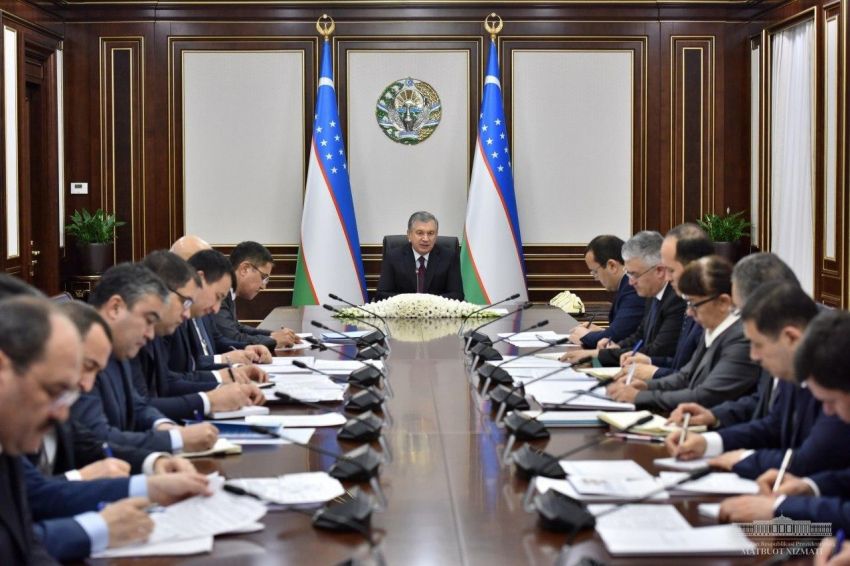
Along with a sharp reduction in state intervention in the sector, this will put an end to regional governors’ pursuit of production quotas and cases of forced labor.
The cluster system is an important factor in the transition to market principles. To date, 73 cotton-textile clusters have been established in Uzbekistan. Last year, they accounted for 73 percent of the cotton harvest. The average yield at these newly established entities was 4.1 centners higher than on non-cluster farms, and an additional 428,000 tons of cotton was procured.
The meeting set tasks for defining the legal status of clusters, introducing transparent mechanisms for their selection, and establishing relations between clusters and farmers.
The organizational work was strongly criticized. In particular, 27 clusters had been allocated more land for cotton production than they were capable of cultivating, while some other clusters, with the capacity to process 500,000 tons of cotton fiber, had not been allocated sufficient land.
The President noted that the main criteria for establishing clusters should be the planned level of deep processing of raw materials, the volume of investment, and the availability of sufficient funds to settle accounts with farmers.
It was emphasized that cooperatives involving farmers would be established in cotton fields not covered by clusters. Cotton ginning plants would be transferred to farmers to organize these cooperatives, and the income generated from added value would be distributed among the farmers who are members of the cooperatives.
The Ministries of Agriculture and Justice were tasked with clearly defining the responsibilities of clusters and farmers and developing mechanisms to regulate their activities.
It was noted that the existing system for financing cotton procurement was not entirely suitable for clusters. In this regard, instructions were given to improve the system of financial support for clusters and farmers.
The measures to be taken during the current year and in the longer term to abolish state procurement orders and gradually abandon the mandatory crop-placement system by 2023 were examined in detail.
Reports were heard from the officials responsible for the issues discussed at the meeting.



 1253
