

- Tasks defined for the effective organization of fruit and vegetable clusters 11
- The updated list of "red," "yellow," and "green" zones of the country has been published. 11
- The President Held a Meeting with the Activists of Bektemir District. 11
- The deputies approved the candidacy for the position of Minister for Support of Mahalla and Family of the Republic of Uzbekistan. 11
- Measures have been defined for the gradual easing of quarantine restrictions. 10

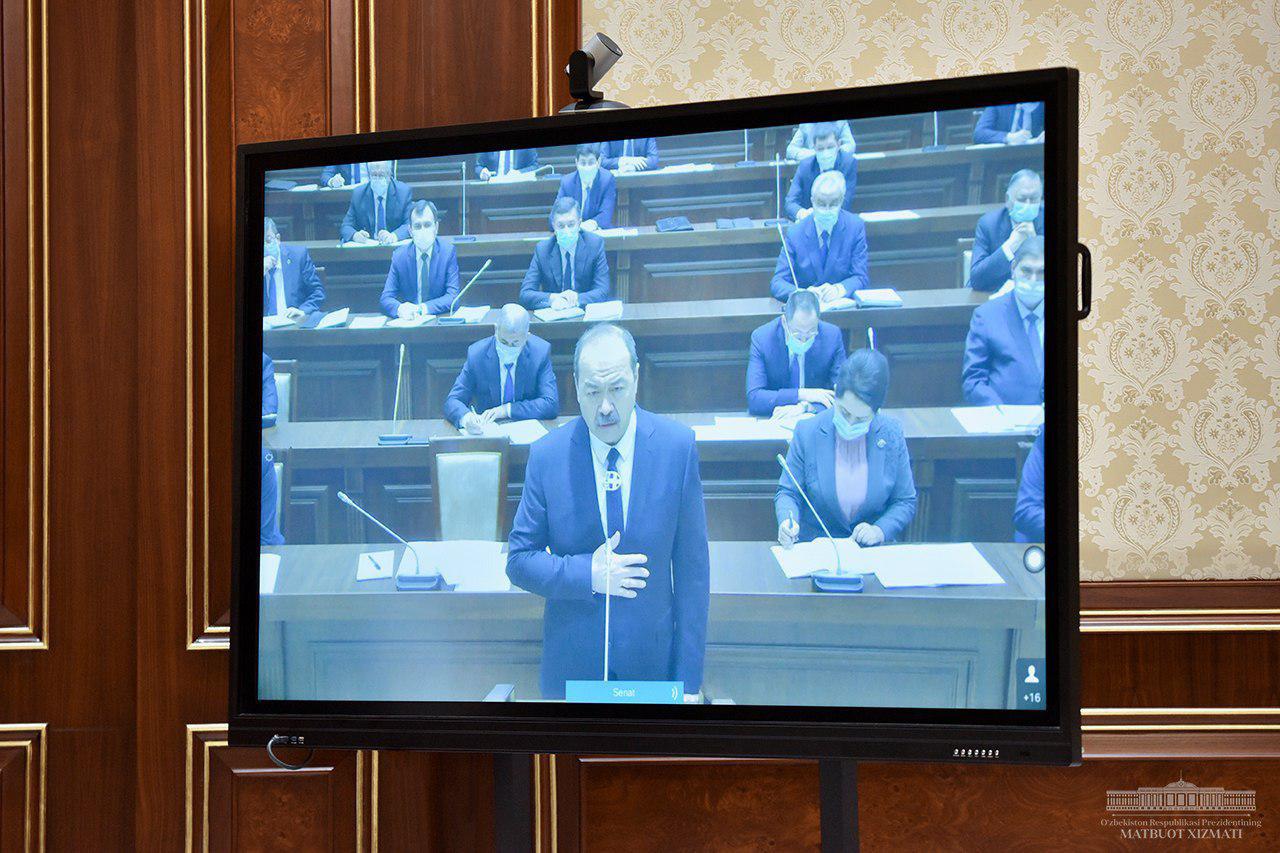
Под председательством Президента Республики Узбекистан Шавката Мирзиёева 8 апреля состоялось видеоселекторное совещание, посвященное анализу результативности проводимой на местах работы по противодействию пандемии коронавируса, вопросам развития приусадебного хозяйства, являющегося важным фактором обеспечения продовольственной безопасности, занятости и доходов населения.
As is known, the Head of State has adopted a number of important decisions aimed at containing the spread of coronavirus and minimising its negative impact on the lives of the population and the country’s economy. In particular, a Special Republican Commission has been established, and comprehensive measures have been launched to stabilise the epidemiological situation, protect public health and introduce quarantine restrictions.
Particular attention is being paid to increasing the preparedness of medical institutions and building additional capacity. In particular, a specialised hospital with 10,000 beds is being constructed at an accelerated pace in Zangiata District. A quarantine facility for 10,000 people has begun operating in Yuqorichirchiq District. Construction has also begun there on another quarantine facility with a capacity of 10,000 places, which is scheduled to become operational by 15 May.
The meeting noted that over the past month, 6,000 citizens had been brought back to the country on 20 charter flights, while another 10,000 had returned by rail and through border checkpoints. All of them were placed under quarantine at 160 facilities.
An operational headquarters comprising experienced doctors and professors has been established to provide round-the-clock online consultations on the treatment of infected patients. Virologists from China and South Korea have been invited. Telemedicine technologies are being used to facilitate cooperation with specialists from Russia, Germany, Japan, Turkey and other countries.
“The most important thing is that the overwhelming majority of our people are taking a sensible view of the situation, working remotely, strictly following doctors’ recommendations and quarantine requirements, and setting an example for everyone through their culture, awareness and discipline. Our school pupils and university students are continuing their education through online lessons,” the Head of State said.
An effective system has been established to ensure the uninterrupted supply of food products, medicines and medical equipment. Charitable sponsorship provided free of charge by our generous compatriots is being delivered directly and in a timely manner to socially vulnerable groups of the population.
As the President noted, the readiness of our people to confront this threat shoulder to shoulder is clearly demonstrated by the fact that, in a short period of time, citizens, state and non-governmental organisations have transferred more than 50 billion soums to Uzbekistan’s “Mercy and Health” Fund.
“During this difficult period, our multinational people are not giving in to panic or confusion. On the contrary, they are once again demonstrating their iron will, mutual respect and solidarity, confident that this calamity that came from abroad will soon pass and better days will follow,” Shavkat Mirziyoyev said.
In the regions, dehkan farmers and agricultural producers have begun their seasonal work, making the most of every spring day.
Production at strategic industrial enterprises and major construction sites is being organised in strict compliance with quarantine regulations.
“In short, life in Uzbekistan is continuing steadily. Most importantly, the selfless service of many thousands of our compatriots, especially doctors, their dedication to their work, as well as the prompt measures being taken, are producing positive results,” the President said.
Unfortunately, a 40-year-old patient died yesterday. Despite unprecedented public awareness efforts, he had been receiving treatment at home and was hospitalised only after his condition had become critical.
Having expressed his condolences to the family of the deceased, the Head of State once again urged everyone to exercise caution: “If you experience any symptoms of the disease, seek medical attention immediately. I repeat: first and foremost, our own safety and the protection of our families and loved ones from the disease depend on us!”
There have also been cases of violations of quarantine and sanitary regulations.
For example, nearly 47,000 violations of quarantine rules have been recorded over the past period. These included 34,000 cases of people moving around without masks and 11,000 violations of restrictions on motor vehicle use. Those responsible were fined. Furthermore, 24 cases were identified involving family gatherings attended by hundreds of people.
“We will emerge from this difficult trial, which the whole world is experiencing, even stronger and more united, with the help of the Almighty. If we strictly observe order and discipline, do not give in to panic and remain resolute, we will prevail.
These temporary hardships and challenges will certainly be overcome. Many more good days lie ahead for our conscientious, devout and resilient people. We will celebrate many more holidays and festivities together and will certainly achieve the goals we have set,” President Shavkat Mirziyoyev emphasised.
The coronavirus pandemic has clearly demonstrated the inadequacy of food security policies and measures in countries around the world.
The Head of State noted that Uzbekistan has substantial reserves and opportunities to fully meet domestic demand for food products and increase the income and well-being of the population.
To achieve this, the planting of spring crops must continue in compliance with quarantine measures: farmers, clusters and dehkan farmers should cultivate their fields, while households should plant crops on their own garden plots. Otherwise, it will naturally be difficult to maintain stable prices in the domestic market.
For this reason, in recent years a number of documents have been adopted to promote the effective use of household plots by the population, and amendments have been made to certain laws. A separate deputy position responsible for household plot issues has been introduced at the Ministry for Support of Mahalla and Family, its territorial divisions and citizens’ assemblies of mahallas.
The Council of Farmers, Dehkan Farms and Owners of Household Plots of Uzbekistan and its regional branches have been established. The operations of 244 “Tomorqa xizmati” enterprises have been organised to deliver seeds and seedlings to households and provide relevant services. A total of 350 billion soums has been allocated from the state budget for implementing new projects on household plots, and a special fund has been established under the Council of Farmers.
Overall, a new system has been created to provide the population with material and financial resources.
During the video conference meeting, additional tasks were set to ensure the effective use of this system and increase the productivity of household plots.
The need to widely disseminate the experience of household plot owners who achieve high yields and incomes was emphasised. For example, many household plot owners in Asaka, Oltinkul, Namangan, Uychi, Angor, Jarkurgan, Kitab, Taylak, Samarkand, Yangiyul, Zangiata, Oltiariq, Kuva and other districts harvest crops two or three times a year. One family earns an average of 50–60 million soums from 8–10 sotiks of land, while some earn up to 100 million soums.
However, such results are not being achieved everywhere. Planting on household plots remains incomplete in Samarkand, Kashkadarya, Khorezm, Bukhara, Syrdarya and Jizzakh regions.
Responsible officials have been instructed to work with the owners of these plots and organise the planting of crops that are in high demand on the market.
The President noted that, given the challenging situation, the top priority this year should be to plant crops two or three times and obtain additional harvests on all household plots.
The establishment of compact greenhouses is also important. At present, household plots contain lightweight greenhouse structures covering a total area of 4,000 hectares. They can produce three harvests a year.
It was noted that insufficient attention is being paid to this issue in many districts. The need to establish greenhouses measuring 1–1.5 sotiks in at least 100 households in each sector under the “Every Family Is an Entrepreneur” programme was emphasised.
Household plots need water. Last year, 233 wells were constructed in local areas, improving water supply to more than 4,500 households.
At present, water supply to household plots is difficult in most villages of Jondor, Shofirkon, Bakhmal, Farish, Guzar, Chirakchi, Nurata, Koshrobat, Urgut, Khavast, Bekabad, Yazyavan, Koshkupyr and other districts.
In this regard, the Council of Farmers, Dehkan Farms and Owners of Household Plots has been tasked, together with district governors, with constructing artesian wells in mahallas where access to water is difficult and increasing crop yields.
Bringing temporarily unused agricultural land into cultivation and using it to provide employment for low-income families is producing good results. For example, 31 cooperatives have been established in Andijan, Namangan and Fergana regions, providing jobs for 1,600 unemployed citizens. To provide financial support for the cooperatives, 50 billion soums has been allocated from the fund of the Council of Farmers, Dehkan Farms and Owners of Household Plots.
At the meeting, instructions were given to introduce this experience in other regions as well and to reduce poverty and unemployment.
A total of 24 billion soums in subsidies will be allocated from the fund of the Ministry of Employment and Labour Relations to unemployed people who have joined cooperatives, to cover expenses related to the procurement of agricultural products. Fruit tree seedlings, vegetable seeds and other material resources will be delivered to low-income families and families without a breadwinner.
Attention was also paid to supplying products grown on household plots to domestic and foreign markets.
In the current difficult period, leaving household plots uncultivated and growing nothing on them should be regarded as an abuse of these land resources.
It was emphasised that owners who use their household plots inefficiently will receive an official warning, while those who still fail to cultivate crops after the warning will be subject to an increased land tax rate. Responsible officials have been instructed to adopt the relevant document. Instructions were also given to monitor the condition of household plots using drones and implement the necessary measures to ensure their effective use in each sector.
Responsible officials and district governors provided information on the issues discussed at the video conference meeting.



 1253
